


When I was a kid, I never thought I would have a superpower. Not everyone would agree, let alone understand why I call being dyslexic just that.
Growing up outside a small town called Ayr, on a dirt road in rural Ontario, my parents never even had a clue what being neurodivergent even meant.
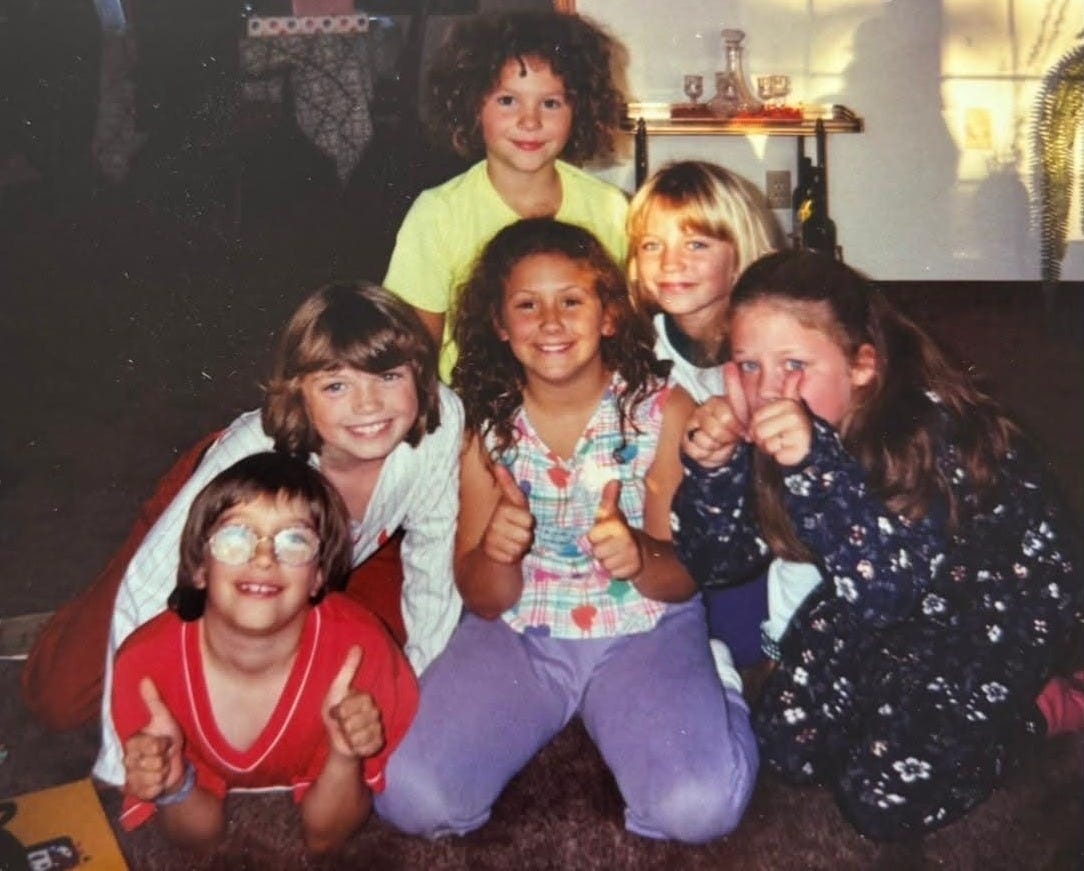
I Was a Child Living With a Disability. But I Was Never Defined by It.
Something many people don’t know about me is that, at the age of five, I was diagnosed with Legg-Calvé-Perthes disease. What is that, you ask? Commonly found in boys, I was the unfortunate girl who developed it. The National Health Institute classifies Legg-Calvé-Perthes, or Perthes disease, as a childhood hip disorder that happens when blood flow to the ball of the hip joint (the femoral head) is temporarily lost, causing the bone cells to die.
Nothing a 5-year-old could comprehend. For over 3 years, I was in and out of Sick Children’s Hospital in Toronto, living with my Mom in a hospital room while my Dad took care of my sister and my cousin (who lived with us due to my aunt passing at the age of 22, his mom). It was an absolutely horrible time for the family, and to this day, I have no clue how my Mom and Dad survived all of it.
In and out of hospitals, I was bedridden for months. The only activity I could really do was being wheeled to the arts and crafts room, where I would draw and create art for hours. I loved it. That was the only thing that made me utterly happy at Sick Kids, along with the puppet that would come visit once in a while.
When I was finally out of the hospital after a year or more, I was still bedridden. Eventually, I got a plaster cast and later, finally, a metal brace with a bar in the middle of both.
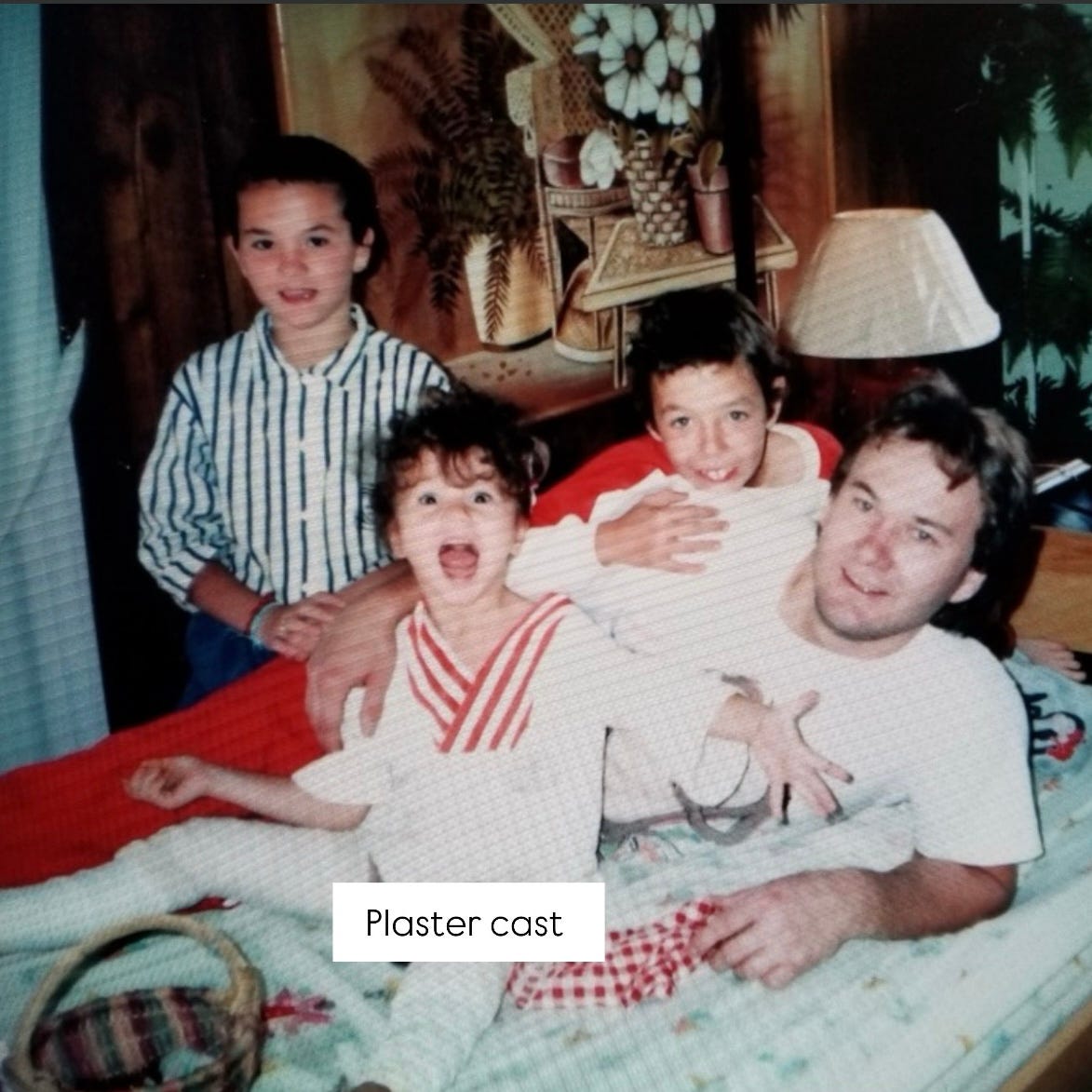
I was a 5-year-old child who looked like Forest Gump. Yup. Not even joking.
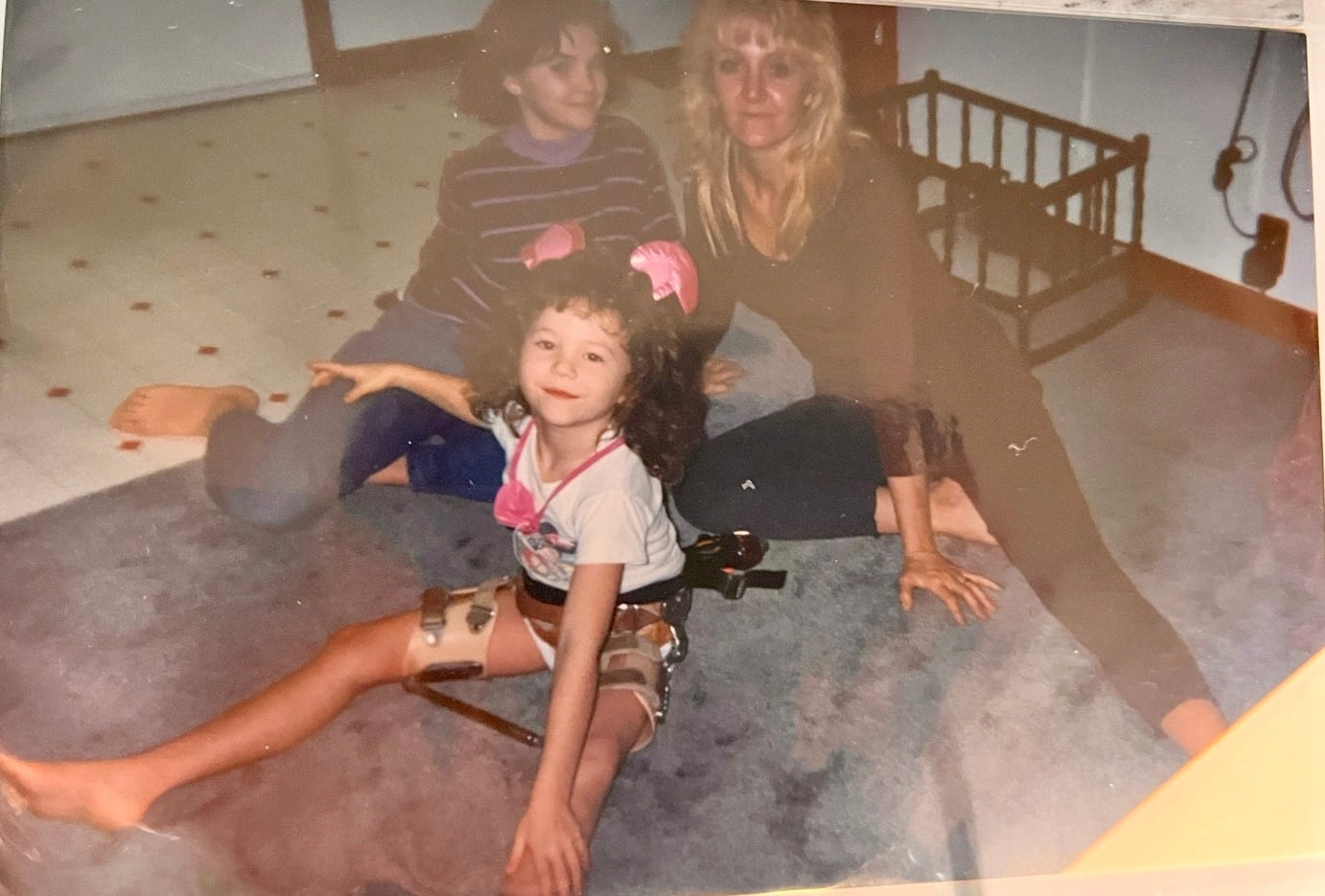
I had braces between my legs, but let me tell you! That did not stop me.
My mom told me the school called her one morning and said,
“It took Chrissy one hour to ‘walk’ to the front of the school doors from the bus.”
My mom, sounding pretty stern with the teacher, said, “I don’t care if it takes her all day. She’s going to learn how to adapt.”
And so I did.
By the end of the week, the teacher called my mom to apologize, saying I was climbing the monkey bars with my braces like it was no issue!
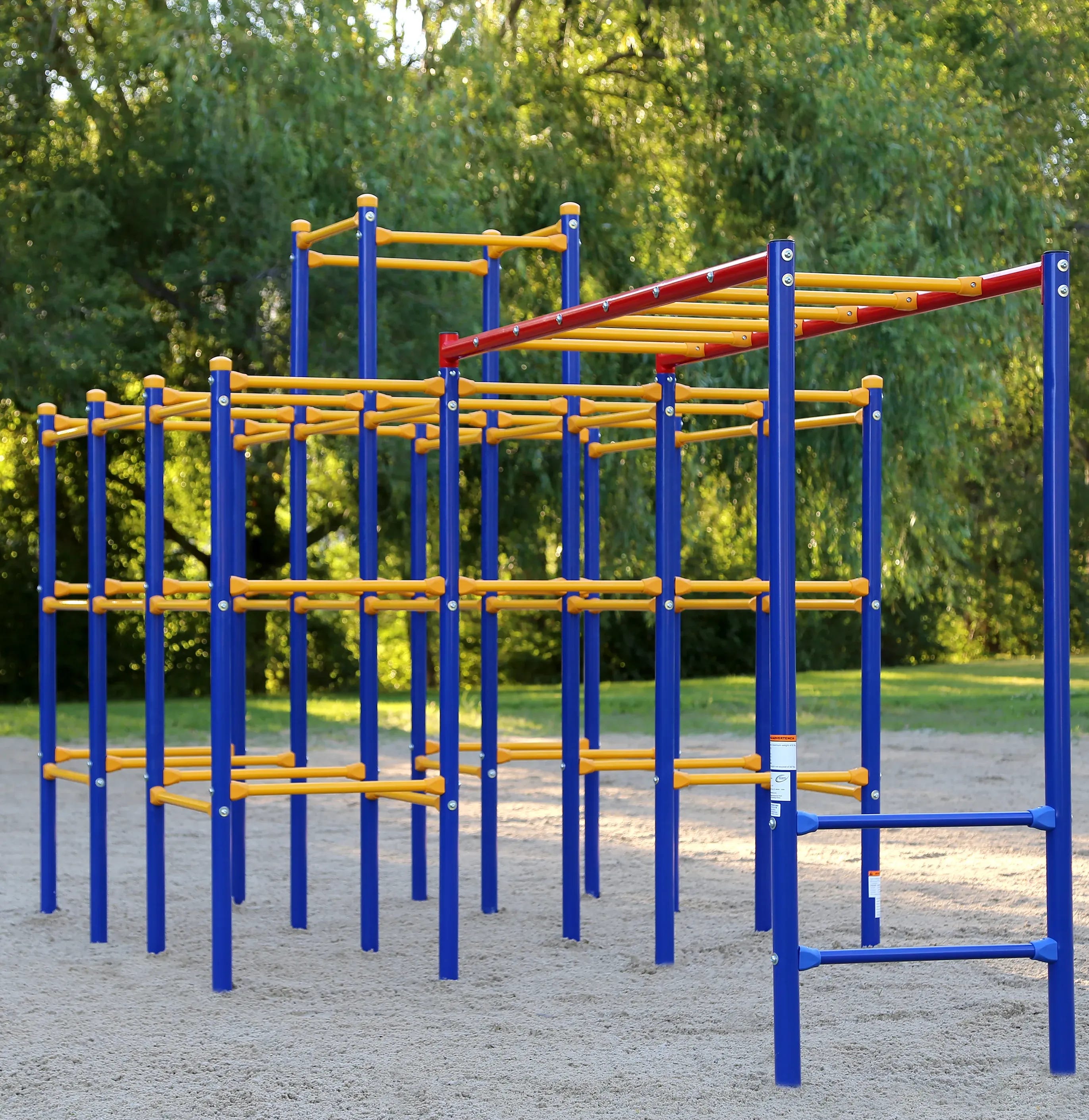
I was climbing with my metal brace on TOP of this thing like a little monkey!
When I look back on that story now, I realize, “Wow, I was a little girl with a 10-pound (or more) leg brace climbing the monkey bars and the jungle gym and pulling it up as I climbed to the top!” Nothing could stop me.
And it hasn’t to this day.
Thankfully, when I was around the age of 7 or 8 (I believe), after soooo much traction and the love and dedication from my Mom and having me heal naturally, I was able to overcome the disease and did not need to have an artificial hip replacement at such a young age!
I was cured!
How does this connect to dyslexia?
Around the same time, I was also diagnosed as dyslexic. But they couldn’t fully admit it, since they said my reading comprehension was high, but my spelling and grammar weren’t (it's all a sliding spectrum; if you know, you know).
So I would hide it.
I didn’t want people to know I had a learning disability.
I hate to use this word, but honestly, I thought I was stupid because of it.
I would leave class during the day and go with another teacher for one-to-one tutoring. It helped, but in all honesty, the Western public school system is not set up for people who are neurodivergent. So I had to teach myself how to learn. Just like I did with the leg braces and the jungle gym.
This day will remain in my memory bank forever. My Grade 8 basketball coach, Mr. C, was driving me home after basketball practice, and he said to me,
“You’re smart, Chrissy.”
(Gosh, I can’t even write that line without crying a little).
“I am?” I said. “Yeah, you are!” he pushed.
That was the first time anyone in my life ever told me that. And to this day, I thank Mr. C for seeing a little girl in a car trying so hard at living life in a system that wasn’t built for her.
When a counterintelligence official, a comedian and a journalist walk into a bar.
It took me to the ripe old age of 38 to finally admit I was dyslexic. On Aug. 20, 2022, comedian Dave Foley, counterintelligence official Luis Elizondo, and I had dinner in California at El Coyote Mexican Café on Beverly Boulevard (Fun but dark fact: it was the restaurant where Sharon Tate had her final meal before she was murdered on August 8, 1969).
Dave had never met Lue before and, well, Lue did not know a thing about celebs due to being active military most of his life and being in the field, and Lue was curious about who Dave was. So I thought, well, I should arrange dinner!
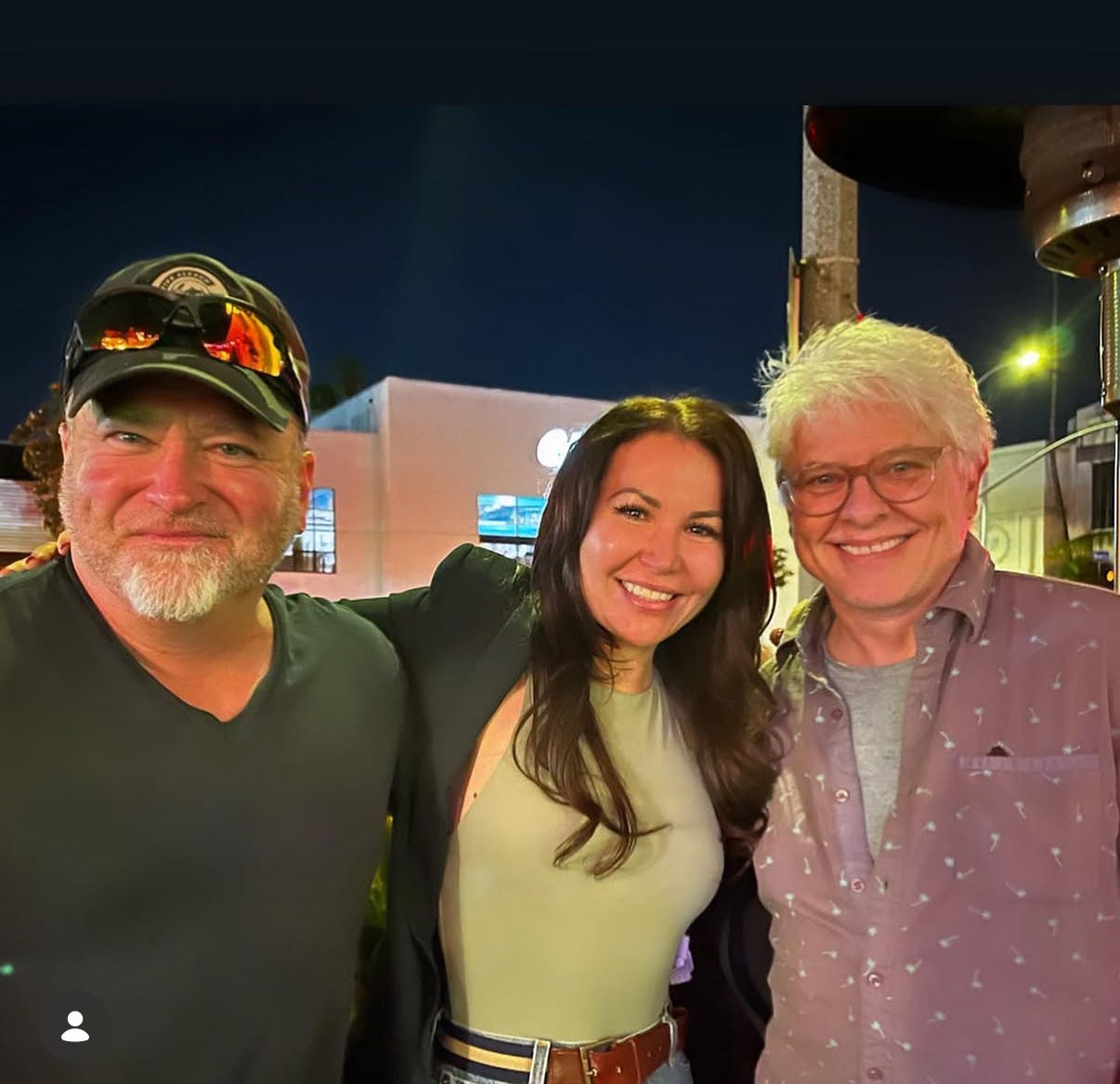
As we talked about everything UFOs and more, I remember Lue saying to all of us,
“I am dyslexic.”
And Dave said, “So am I!”
And then they both turned their heads and looked at me.
I said nothing.
But inside I said all the words:
“Do they know!?! How do they know?! Should I say I am too?!”
Instead, I just looked at them and said nothing.
I thought to myself, “Why are you so scared to tell people who you really are?”
I sat with that for a while.
Neurodivergent Friends and Saving the World
My good friend Alyssa, who I’ve known since I was 14, would get together and talk about what the future might hold for society. She was the person who got me on the neurodivergence train. She and I would talk at her house about how the workforce needs to change and will, in the future, make room for people who are neurodivergent. She was right, like a typical neurodivergent would be! Predicting the future one friend conversation at a time. She planted so many wonderful ideas of the term, and then I was off on my merry way to research it even more!
But should I tell anyone besides my friends?! Will people still respect me? That fear of being considered “stupid” crept back into my life.
Until one day, I said fuck it. I started talking about it on my podcast. It was a neurodivergent coming out of sorts. And I was proud and loud!
Years later, I told Dave Foley about that night and confessed that I had never told him or Lue that I was dyslexic. I thanked him for telling me because it gave me the courage to step into my own light. If you’re reading this, Dave, thank you again, my friend. I love you for helping me along that road and not even knowing it.
Stealth Dyslexia
As I learn more and more about my neurodivergent brain, I recently found out that I may be a “type” of dyslexic, as I carry many of the traits associated with it. I didn’t even know there were different categories of dyslexia!
It’s called “stealth dyslexia.” Pretty cool name, right?! 😂
The Davidson Institute describes stealth dyslexia as a hidden form of dyslexia where high intelligence and strong reasoning skills allow a person to compensate for reading and decoding words.
The more I learn about neurodivergence, the more I realize it’s all about how your brain processes information - “The way my brain works.”
Being "smart is not about if you’re really good at spelling or grammar; it’s about how fast you process information. (But also, let's be honest: there are many ways to be smart, not just one).
Our brains are little computers, and I’m pretty sure my comedic side of the mainframe was built by a Muppet. Lol. But we can get into my love of Muppets for another Substack. (Gonzo is the best one, btw).
If you didn’t know this, dyslexia is also sometimes associated with high pattern recognition, heightened empathy, and emotional sensitivity. While empathy isn’t a diagnostic trait of dyslexia, researchers discovered connections between dyslexia, creativity, emotional awareness, and strong social awareness. Okay, okay, I’m not saying I’m always self-aware. You can’t be all the time, and self-awareness grows at a similar rate as wisdom, I would say.
However, as I get older, I realize that so many brilliant minds and creatives like Steve Jobs, Whoopi Goldberg, Jennifer Aniston, Cher, Steven Spielberg, Picasso, and so many more were ALL dyslexic!
The older I get, the more I realize I’m not alone in this struggle, and I should be proud of who I really am. A smart woman who is dyslexic. A hidden superpower.
I See My Challenges Differently
Looking back now, having both a physical challenge and a learning disability growing up really opened my eyes and empathy for people who struggle with any of these disabilities daily. No, it doesn’t define us, but it makes us strong. One building block after the other to make change, see each other for who we really are (superheroes who can’t spell well, lol), and love everyone for being different and NOT the same.
Since I am dyslexic, my writing is 100 percent mine on this Substack (it’s my voice, as you can tell if you know me), but I will be honest and say that AI helps me with spelling and grammar. I’m horrible at both. Trust me. The thing with me is, I love to tell a story. And I don’t care if I can’t spell well or my grammar is not that great. What makes you a compelling writer is having a voice, a narrative. Some of the best writers ALSO have great editors by their side. Unfortunately, for this Substack, I'm the only editor.
In the end, I will tell stories for the rest of my life, and a little learning disability won’t stop me.
So I will leave you with this.
Maybe understanding and decoding our brains is one of the most interesting ways to find your personal (inner) singularity.
**Dedicated to:
This article is dedicated to the two paying subscribers (as of now) to my Substack, both academics, good men, and know about my dyslexia. Thank you for believing in me, supporting my work and vision, and being two wonderful humans I feel honored to call my friends.
Chrissy Newton, journalist for science, technology, and defense news outlet The Debrief and the founder of VOCAB Communications. She currently appears on The Discovery Channel and Max and hosts the Rebelliously Curious podcast, which can be found on YouTube and on all audio podcast streaming platforms. Follow her on X: @ChrissyNewton, Instagram: @BeingChrissyNewton, and chrissynewton.com. To contact Chrissy with a story, please email chrissy @ thedebrief.org.
Wow, just wow!!! Love you sweet warrior for this!!! You are the bravest being I know. Thank you for paving a road for the rest of us! You really are magical and a true gift to this world and mine.
And hilarious! “My comedic brain was built by a muppet!” 🤣 I adore you!!!
I did not expect to relate so much to this story in certain ways. When I was a kid, I had issues with my feet due to short achilles tendons. I had these copper/brown metal braces on the bottom of my feet [clamped onto an ugly pair of shoes] that were supposed to keep my feet growing straight in my sleep. I eventually had surgery for it too. I had a metal knex set looking contraption on both legs for close to 2 years. It held 8 bicycle spoke metal pegs through the bones in my legs. 4 in the feet, 4 above it in the shin making an asterisk-like pattern basically. *
I can still feel where those went in. When they finally came off, I had casts for most of the school year, and then inflatable things around my shins for a long time after that. I also got diagnosed by a psychologist with a math learning disability.
It's interesting to me reading this from you. Now I'm like... Shit, does every kid go through the same templated life challenges like video game levels?! High strangeness in my own mind. I also have the pattern recognition thing real strong, so I totally get what you're talking about. I'm seeing it by how much this had me thinking about my own past.
Proud of you for feeling comfortable/proud to speak your truth out loud. I'm basically learning to do the same. But I haven't had the courage to put my own name and face to my substack yet. So we all have our thing. Great read! Thanks for sharing.